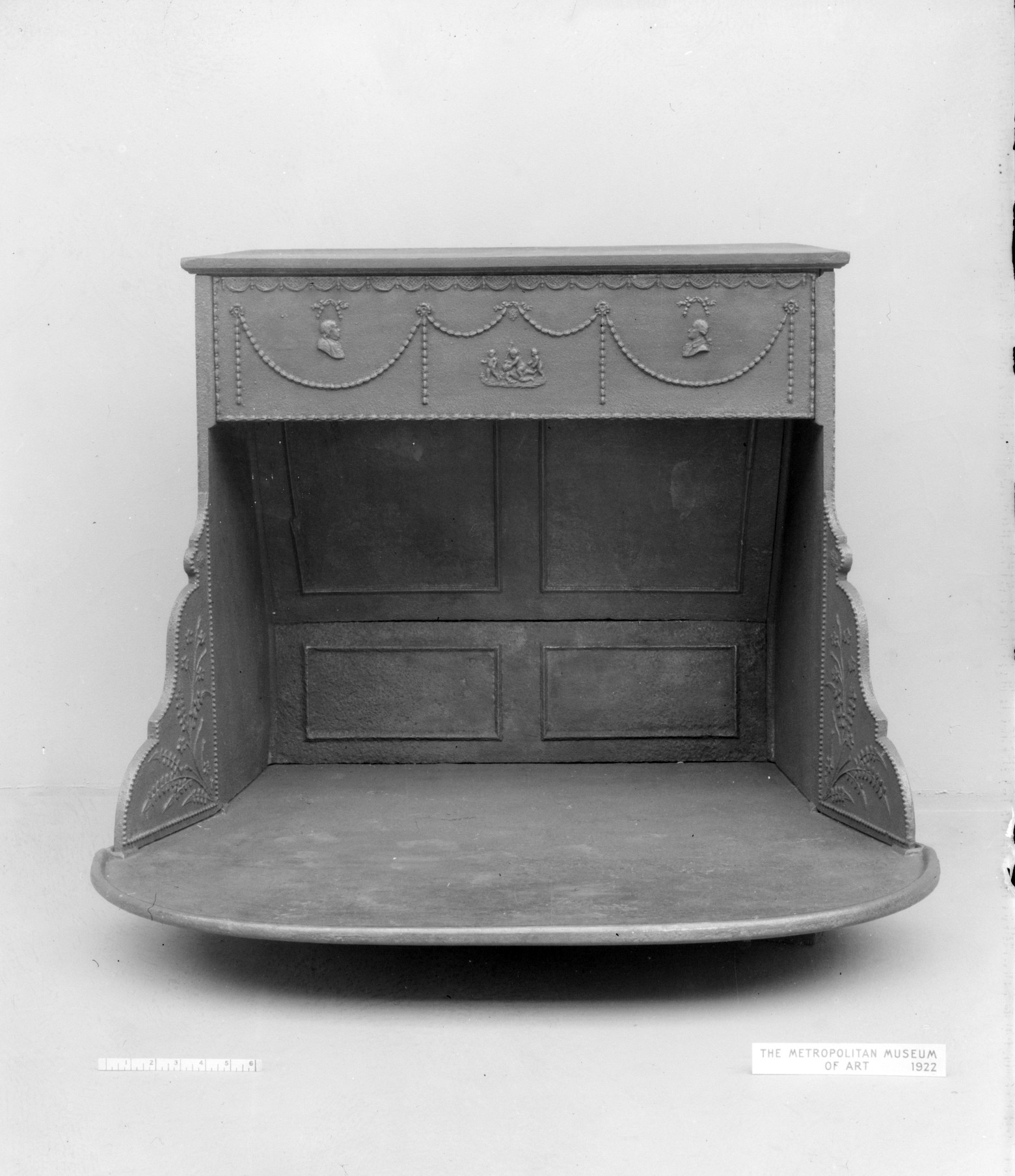
Here's what I discovered: one of the most important stoves, from one of the most significant early inventors and makers, was going on sale, in Philadelphia, in the near future -- http://kamelotauctions.com/images/57/lots/20433-77a.php, http://www.liveauctioneers.com/item/22979460_signed-cast-iron-stove-c-1835. Until I told the auctioneers about it, they didn't really know what they had (they thought it was fifty years younger, and therefore much less rare and potentially valuable). They responded by correcting their description. This wasn't the end of my writing around about it. I persuaded myself that this was an important piece of history, and it ought to be in an appropriate public museum rather than to disappear again into a private collection. So I tried to interest various curators in it, with rather limited success. I even considered buying it myself, and trying to persuade a museum at least to accept and conserve it. But in the end I didn't bid (I feared that I might find myself with several hundred dollars less, and a storage problem for several hundred pounds of old iron, several thousand miles from home -- not at all convenient!), and happily I didn't need to. This old Mott stove is going to a good home, Hyde Hall historic house in Cooperstown, New York, where its classical styling will help it fit in nicely.
I wrote the following blog entry to work out for myself what exactly I was looking at, and as part of my campaign to persuade others of the importance of this battered old survivor from America's first great age of stove invention and manufacture.
22 Jan. 2014
(1) The object itself:

Here it is, in all of its glory: a small stove, just 21.5" wide x 17" deep x 23" high. Its unusual vertical grate is flanked by shallow, flaring jambs, and surrounded by a sort of miniature cast-iron mantel, or fire-frame: classical columns surmounted by a decorated entablature with mythological figures at either side of the most prominent feature of the stove, its maker's name and claim.Its

This side view shows the flare of the jambs clearly, and also that this appliance is meant to stand out from a wall rather than be buried in the recess of an existing fireplace -- the other principal way of placing a stove in a household setting. How do we know this? (a) Because the side plate, too, is decorated -- pointless if the stove is meant to be sited in a recess; (b) because if it wasn't free-standing, it would have been almost impossible for a cook to make use of the large, covered hole in the top -- lifting heavy pans on and off, or stirring food while it cooked, would have required plenty of clearance above it, that no ordinary fireplace recess could have provided. Below the grate can be seen a sunken ashpit -- a common feature of wood stoves since at least the early 1820s, making it much easier to remove the ashes without getting them everywhere, and also providing a bed of glowing coals over which some cooking operations could be carried out. There would have been a removable cover for this pit, which has been lost, but could easily be replaced with a new steel plate.

In this detail we can see two important features of the design:
- first, the designer and maker's name, and his claim to exclusive intellectual property in his device, in the most prominent place on the stove, the center of the frieze. (Compare the Wilson's Patent Franklin in the previous post -- i.e. this practice was not new to Mott; it would become the common custom of the trade, and the information provided would become more detailed after the mid-1840s, including not just the patentee's name but the precise date of his patent.) The pattern-maker seems to have had a problem with his apostrophe -- perhaps he only had a comma in his kit of cast-lead letters, tacked onto the wood pattern to add text to it.
- second, the key innovation (which may or may not have been his original idea) that Mott sought to protect from imitation through his patents -- the "self-feeder," i.e. the little hatch with a ring-pull holder, through which small lumps of anthracite could be poured into a magazine from which they were gravity-fed to the grate and burning zone. This meant that Mott's stoves did not have to (indeed, could not) burn the more expensive sizes of large-lump coal then in use, but just the cheap trash, and that they would not need constant attention -- instead, they would burn economically for hours on end. Both of these advantages of the self-feeder turned into significant savings of money and time for the householder, and helped to compensate for the higher prices Mott probably charged for his patent-protected goods.

This top view shows the self-feeder more clearly (including a broken bar, alas -- but after 180 years a bit of wear and tear is to be expected, and it could easily be mended by a skilled welder), and also the single large cooking- or boiling-hole behind the fire, with its cover removed. Mott's stove was meant for an ordinary household -- not the elite and institutional purchasers who made up the Reverend Dr Eliphalet Nott's clientele for his anthracite heating stoves, for which see this post -- for whom the kitchen fire provided warmth for their most important, perhaps their only, living room, and also light, as well as enabling them to do their cooking, boil water, etc. The cover may or may not be original, not that it matters -- parts of stoves most exposed to heavy use often broke, and were meant to be replaced; in any event, it is a simple piece of hollowware. One can also see the head of one of the bolts holding the stove together (lower right-hand corner).

This detail shows the fineness of the casting: after almost 180 years, the lines are still sharp, the relief decorations standing well proud of the surface. However, it is a bit pitted -- whether this is a result of corrosion and recent over-enthusiastic cleaning, or was present from the beginning, would be nice to know for sure, because it is historically relevant (see below).

I do not know what the motif of the two horses' heads beneath an arch of ?vine leaves on the frieze is supposed to be, or mean, and I am equally in the dark about significance, if any, of the folkish musician represented on the side plate. But I am impressed by the amount and quality of surface decoration on what was an essentially utilitarian object. It is impossible to be sure just from looking at pictures (it would be difficult even in an up-close encounter), but my guess is that much of this decoration would have been carved separately from the rather plain wooden patterns for the stove's principal plates, and just glued and/or nailed on -- this had been normal stove-plate pattern-making technique since the late eighteenth century. The main front plate, however, including the jambs, columns, and entablature, was probably carved out of several separate slabs of pine and then assembled into a single pattern to cast the whole thing in one piece. Mott's pattern maker was probably Isaac Deaves (b. 1776), one of the most experienced stove-pattern makers in Philadelphia, the center of the trade; Deaves certainly made Mott's other early stoves, including one referred to in an 1845 patent case as his "Franklin cook stove" with a one-piece cast front, which is almost certainly the stove before us. A slightly later model of one of Mott's stoves shows the same style of applique decoration on its plain flat plates -- compare the catalogue illustration, with the decoration sketched on in a lighter hand, with the original patent drawing (also included below, but inserted here too for ease of comparison):
 |
| Mott, Description and Design (1841), p. 25. |
 |
| Mott, Patent No. 50 (1836). |
The patent Mott refers to on this stove is probably not his first, for an Anthracite-Coal Stove (7096X, 30 May 1832), which was just a plain, oblong, magazine-fed heater, though the drawing does give a good cross-section of his magazine, grate, and burning-zone, which is essentially the same arrangement as in this and most of his other stoves, but his second, for a Magazine Stove (7910X, 30 December 1833). This was also for a heating stove, but it had the same flaring jambs around the grate, as well as the more elegant styling, and indeed a limited cooking capability, of his later combined heating and cooking stove, which we have just been looking at.


How did Mott get from his 1833 design for what looks like quite an elegant space heater, suitable for an office, hotel lobby, or hallway, rather than a domestic kitchen or parlor, to the squat, square combined cooking and heating stove we see before us? Any answer must be partly speculative, but most of it is provided by the man's own explanations for the evolution of his own ideas, contained in his patent documents and his 1841 catalogue, the Description and Design of Mott's Patented Articles, Secured by 27 Patents ... (New York, 1841), of which the only surviving copy is in the Winterthur Library, and elsewhere.
 |
| Not a Mott pyramidal stove, but about the right date (1838) and city (New York) -- gives a sense of the kind of public context in which his heating stoves had to fit. |
The text of patent 7910X makes it clearer than the drawing that his device was in fact already designed with several objects in view: he was attempting to produce an appliance to compete with the "Open Franklin," giving a good sight of the fire, and with flaring jambs to reflect the radiant heat; to have in addition the advantages of a "close stove" in terms of heat output (hence the large body and decorative fluted stove pipe, to maximize heat transfer into the room); and also to have a small opening in the top for a cooking pot, which is barely visible in the right-hand drawing (the first opening, in the front of top by letter A, was for the fuel-feed; behind it was another, for cooking).
The stove as drawn cannot have been a very convenient cooking device -- suitable for boiling a tea-kettle, perhaps. But to broaden the demand for his stoves in the very competitive New York market, Mott had to make something more useful to an ordinary household, whose kitchen was also their main or only living room, particularly in winter; or who, even if they had a separate parlor, did not wish to heat two rooms unless they had to, so would appreciate a device that was both an attractive piece of furniture and a serviceable dual-function appliance.
Mott was not the only New York designer trying to meet this need. At the Seventh Annual Fair of the American Institute, held at Niblo's Gardens in October 1834, Mott won a first premium for his office stoves, and a second (behind Nott & Co.) for his anthracite coal cooking stoves (see illustration below), but his neighbor and rival William Naylor's coal cooking stove was "acknowledged the best article of the kind ever brought into the market." It was of a quite new type known as an "Oven Franklin," i.e. it had an oven behind the fire, with two boiler-holes above; it also had an attractive, decorative front plate, like an ordinary Franklin, so that it could enhance a kitchen or grace a parlor with equal ease. My surmise is that, in altering the proportions of his 1833 stove, and making it a more effective cooker, with a larger boiling hole (albeit that it lacked an oven -- something other Mott stoves already possessed; and housewives could in any case cook in front of an open Franklin with a reflector oven or "tin kitchen"), Mott also made sure that it looked more like a Naylor.

Naylor's device was much simpler than Mott's -- though the above illustration shows its claim to be a patent product on the oven door, no stove patent was ever issued to Naylor (perhaps he applied for one unsuccessfully, but claimed the patent anyway, or in optimistic anticipation; or perhaps he had bought the right to use another, unknown, designer's patent?). His was just an anthracite-burning grate, whose wide bars make clear that it was designed to use the larger sizes of coal, as most were at the time, with an oven and boiling-holes attached to the back of the fire and heated we know not how (i.e. it would be interesting to see a cross-section of the flues), or how effectively (he claimed to have made significant improvements in these respects over his previous year's model).
 |
| Thomas Shaw (North Yarmouth, Maine)'s "Cooking Stove" Patent 9776X (1836) -- The best of the few surviving Oven Franklin patents, with a grate for coal or wood, and also a crane, so that the housewife could cook on it the old way as well as using the boiling holes and oven. The flue arrangement is probably like Naylor's, though his is less of a transitional device. |
What Mott had to do was to combine the innovative design elements of his stoves -- the self-feeder, the ability to burn cheap, smaller sizes of coal -- with a more conventionally attractive appearance than 7096X's or even 7910's, and at the same time work on perfecting the ease of manufacture and the durability of his stoves. He was already making proper cooking stoves, with an oven and a number of boilers, but though they were capable of winning second prize in the 1834 American Insitute fair, none of them appear to survive, and available drawings of them are rather sketchy:
.jpg)
Even in this drawing, we can see the flaring jambs, the self-feeder [A], and the cooking-hole above the fire [B-C]. What this Mott stove, illustrated on p. 7 of his 1841 Description, possesses in addition is an oven, protected by firebrick from the intense heat of the fire, and heated by flues passing over and under it. This was the conventional layout of a wood-fired step (alternatively horse-block, Jew's harp, or Premium) stove, of a kind manufactured in Vermont and Upstate New York since the 1820s. Mott was later quite critical of it. In 1835, the first year they were "offered for sale in any quantity," the "ovens and fixtures ... were small, the fireplace large, and the castings rough and heavy. This resulted from the lack of practical experience by the inventor, who was then a grocer" [see below]. But the "principle upon which they were constructed was good.... The faults ... were in form and arrangement, or the style of finish." And on this imperfect foundation, rapidly improved, he would build his fortune.
It seems clear that the stove currently on sale is basically the front part of that 1835 cooking stove, but designed so as to compete with an Oven Franklin like Naylor's, in appearance at least, and thus to fit in the market niche intended for it. It also includes features Mott did not introduce before 1835: casting the front in one piece, and ribbing the curved plate above the grate, to prevent cracking and warping. When his 1833 patent stove was first introduced, the front plates were cast
.jpg) |
| Mott, Description, p. 9. The ribbed plate on the stove for sale is indeed held in place with a square nut. |
It seems obvious that what Mott is writing about above, and illustrating in Fig. 11, is almost the stove that is now on sale. However, it lacks the self-feeder, and the large hole in the top plate is both for adding fuel to the fire or, with its cover removed, putting in large cooking pot to sit above the flames:
.jpg)
This may have had the virtue of simplicity, but it cannot have been very satisfactory -- even with a strong chimney draught, fumes from burning anthracite must have seeped into the kitchen (though of course Mott does not say so). So it is understandable that, in a device intended for the kitchen or the parlor, Mott reintroduced all of the more advanced design features from his parlor and hall heating stoves, and also his proper cooking stoves (i.e. those with ovens).
This particular Mott stove was therefore not earlier than 1835, but also probably not much later. That is because Mott's inventive energies took him in different directions from the middle of the decade onwards, as he experimented with a variety of idiosyncratic ways of making stoves, as he thought, better -- fabricating their bodies of cast-iron rings, bolted together (Heating Stove 8983X, 1835): decorating the rings with cast-iron leaves, making them less liable to crack, and more as efficient heat-transmitters (Stove and Fire Place, No. 50, 1836); making cheap cooking and heating stoves exactly similar in layout to the one on sale out of very complex one-piece castings (Stoves for Burning Anthracite, No. 292, 1837) -- as he explained, "[s]toves of this description have hitherto had the body and feeder cast in several distinct parts, which have afterwards, been joined together by screws, rivets &c." just like the stove we see before us.
 |
| [Described and illustrated in his 1843 catalogue as his "Cinder Burner, or Hard Coal Furnace"] |
Figure 3 for Patent No. 50 seems to show a device that's a development on the one now on sale, both technically (the curved, leaf-hung body) and stylistically (the same classical columns, but a proper pediment, with brass finials at the corners probably masking the tops of the rods, rather than the earlier crude entablature). But it possesses the the same key features, notably a (smaller) round cooking-hole towards the back of the top plate, and even some of the same lesser details, e.g. the distinctive legs.
So there we have it: the stove now offered for sale is a development from the first ones Mott made under his 1833 patent, and similar to, but somewhat less advanced than, those resulting from his 1836 and 1837 patents; which makes an 1835 date for it about as good a guesstimate as I can come up with.
Why is the date significant, rather than merely interesting (or at least "interesting")?
Because it marked an important point in Mott's career as a stove inventor and manufacturer. After several years of experimentation, development, and small-scale production and sale, it was when Mott made the transition from being a grocer with an interest in the technology and business opportunities of the stove trade, into his new career as a very focused and successful stove maker and seller. He had developed a range of products -- variations on the same basic design and ideas, but adapted for a variety of users and uses -- and he now determined to make them on a larger scale and sell them directly himself. 1835 was the first year when he started describing himself as a stove maker (rather than a grocer) in city directories, after he had opened his own workshop and store in Water Street, the heart of the city's stove district.
However, 1835 is also significant for what didn't happen then. Mott later became renowned -- incorrectly -- as the man who set up the first stove foundry in America, i.e. as the first stove designer, maker, and seller who did his own casting, in his own specialized factory, rather than continuing to depend on the charcoal-fuelled blast furnaces of south-east Pennsylvania and south-west New Jersey for his plates, in the way that (almost) all of his competitors had done throughout the first generation of the industry's growth since the 1810s.
But that important development still lay a couple of years in the future. In 1835, when the Mott stove now on sale was probably made, or even in 1836, Mott continued to depend on the industry's traditional suppliers. He later claimed that one of the reasons he soon decided to abandon them and do his own work was that their castings were rough, crude, and heavy. The quality of the stove now on sale suggests that he was, at the least, exaggerating; that, in fact, the blast furnaces were quite capable of producing fine work.
And the significance of this is? The historian (me) seeking to understand and explain Mott's (and others' -- he was either quickly imitated, or more likely he was just one of a number of stove makers who reached the same strategic conclusions, in much the same context, and therefore at more or less the same time) decision to set up his own stove foundry in about 1837 needs to do more than simply recycle, without criticism or addition, the story that has been in circulation since Mott himself started telling it between ten and fifteen years later. This old stove tells us that it was, at best, only partly true.
(3) Who was Jordan Mott, and what did he achieve?
A Google search for "Jordan Mott Coal Stove" throws up plenty of hits and lots of biographical information about him, much of it wrong -- sometimes as a result of misunderstanding of, or misquotation from, the few original 19th-century printed sources on which everybody has to rely, but also because of Mott's success in forging a rather exaggerated self-creation myth, part of which is noted above; one of his more enduring achievements.
 |
| Bishop, A History of American Manufactures (1866), Vol. 2, opp. p. 546. |
When Mott began to experiment with apparatus for burning anthracite better, and then to patent and build saleable designs on the basis of those experiments, he was not a lone pioneer, as his biographies might suggest -- sometimes by the bold expedient of moving the start date for his experiments back to 1819, well before anthracite was commercially available; but usually simply by ignoring the band of other local pioneers who accompanied him, and entirely overlooking anybody who did not happen to live and work on Manhattan. Mott was not even the first city resident to patent an anthracite stove; there had even been another Mott (Stephen, a brass-founder, i.e. a skilled cast-metal worker; I don't know what their relationship may have been, if any), in 1826, by which time established members of the New York City stove trade, serving the largest and most dynamic market in the country, were already advertising and selling their own devices adapted for anthracite-burning (see Postley and Wilson ads in this post). In other words, Mott's choice of anthracite stoves as the subject on which to focus his mechanical and entrepreneurial skills was an intelligent decision to jump on an accelerating bandwagon, rather than an example of the sort of heroic leap of solitary genius that Victorian biographers (and, in Mott's case, autobiographers) chose to depict.
After a couple of years of fruitless experimentation Mott did have a distinctive idea (though not, as he thought or claimed, unique -- it was just new in New York): to build stoves that would use small, cheap, and neglected sizes of anthracite coal, the by-products of an extremely inefficient and wasteful system of mining and transporting the new fuel from north-eastern Pennsylvania to its urban markets. Mott's own earliest recorded account of his motivation (written in 1847, in connection with a patent suit, but not necessarily to be rejected for that reason alone) was that he was inspired by benevolence. He wanted, he said, to work out how anthracite below the two-inch size later known as “egg,” down through “chestnut” and “pea” at least as far as “buckwheat,” and even including the unsaleable waste below a quarter-inch in size later known as “rice,” “barley,” and “culm,” could be exploited as a cheap source of fuel for the urban poor [p. 140].
Early anthracite users preferred to burn large sizes on their grates and stoves – lumps the size of a fist, or even larger, which would later be termed “broken” or “steamboat” coal, the next sizes up from egg, and even more expensive. Small coal did not burn well or at all in most of the appliances available at the time, and was accordingly either left in the mines, discarded en route to market -- even being used for landfill to extend Manhattan's waterfront out into the Hudson and East Rivers – or sold off very cheaply. If Mott could create a demand for it he would also, of course, be making a business opportunity for himself, and not just as a stove maker. He had certainly achieved his breakthrough by 1835, when he scored a commercial coup by buying cheaply mountains of discarded coal waste from the Schuylkill Navigation Company's yards in West Philadelphia, and shipping it to New York, where it now found a ready sale, and enabled Mott to make money twice over, by providing his customers with their fuel as well as with the appliances in which to burn it.
But reaching this point took years of costly effort. In successive winters of experimentation between 1829 and 1832, Mott achieved his objective of discovering how to achieve easy, efficient, and sustained combustion of small coal, and began to shift his focus to a broader interest in how to make appliances that were more durable, simpler, and cheaper to manufacture. All this time Mott continued his principal business as a grocer, depending on that income to pay for his experiments.
And even after he had perfected his stoves he had another challenge to overcome: making and selling them. According to his own account, this was not easy either. Like many pioneers, he “had to contend with the prejudices of the public against a new article.” There was also the question of how to get his products into the market. “As he was not a practical mechanic he had also to contend with superior skill and economy of manufacture” of the established stove makers, so his initial plan was to license his designs to them. “He offered the invention to some of the trade at their own or in fact without price, for a few years, but being unwilling to incur the expense of introducing a new article, or not appreciating its utilities, they declined to accept it upon any terms.” (His 1843 catalogue suggests that this lack of interest in his improvements only affected one product, a feature of a cooking stove, that he had not even invented, just perfected, and in the early 1840s, not the early 1830s; but by 1847 he had broadened and blurred his story, to make it seem as if he had met resistance from the beginning and across the board, which was not the case.) He recalled that they viewed him “as an interloper, I was so called, but few of them would commune with or deal with me.” (In fact, the trade, through the annual American Institute competitions, gave his products many prizes, and paid his ideas the biggest compliment -- they imitated them.)
(A) The Man
Eventually -- and certainly not later than 1835, the year of our stove -- he began to get his own stoves made in the same way that they did, at the charcoal-fuelled rural blast furnaces of south-eastern Pennsylvania and south-western new Jersey, and opened his own premises alongside them, in Water Street on the Lower East Side, to compete against them directly in the same markets. Mott did not just join this trade community of stove makers and sellers, he beat them at their own game, and survived the commercial vicissitudes of the late 1830s and early 1840s that destroyed so many of them, with the result that from 1844 onward the “interloper” became “the oldest wholesale manufacturer in the city.” [1847 deposition and 1851 letter to James R. Smith, chair of the American Institute's Premium
Committee, reprinted in the Transactions of the American Instituteof the City of New-York, for the Year 1851 (Albany: C. Van
Benthuysen, 1852), pp. 139-46, quotations pp. 142, 145.]
So Mott was no ordinary inventor, maker, and merchant, he was a particularly important and, in due course, successful one. The stove now on sale comes from a critical period in his career, when he had just developed a broad product range of heating and cooking appliances, first opened his Water Street workshop and "ware-room" (retail and wholesale store), and was no longer describing himself in the city directory as a "grocer" (his listing until 1834) but instead taking his place among the city's dozen other stove, range, and grate manufacturers and dealers, a place which would soon be that of the leader of the pack.
{Note: I know that this paragraph is a bit repetitive of something already stated, but as far as I am concerned it's in the nature of a blog post, or at least one of my blog posts, to be a bit of a working draft. At some point I will probably come back to this and iron out the repetition, saying things just once, and in the right place; but at the moment I am not sure whether that is here or at the end of the previous section, so I will just leave both mentions in, for the moment anyway. It would help if I printed things out and did a final paper-edit, as with any "proper" publication, I suppose.}
The claims Mott made on his own behalf which, distorted and further exaggerated, litter the internet, and even serious works of quite recent academic history, which may be their sources -- notably that he invented the first anthracite-fuelled cooking stove, as well as opening the first stove foundry, to make it -- are certainly wrong, but in a sense this doesn't matter, if we decide not to get too hung up on claims to priority. Mott occupied a prominent position among the first generation of American stove inventors and makers whose collective achievement was indeed the bringing to market, within a very few years in the first half of the 1830s, of efficient, effective, durable, affordable, desirable and usable heating and cooking appliances adapted to, or designed specifically for, the new fuel; and the stove on sale is certainly a good representative of them all. As Mott wrote, "My object has ever been to make a stove that will meet the wants of the mass. In getting up a new set of patterns, in all cases I aim to make the stove not only economical and efficient, but so simple in management, that the girl who arrives from Europe one day may use it the next." [p. 145]
Contemporaries were impressed by his contributions -- as the Commissioner of Patents, Edmund Burke, wrote in 1836, his inventions, the outcome of sustained empirical work, involved "a beautiful application of philosophical [i.e. in our terms, scientific] principles"; and as Charles S. Paige, the Principal Examiner of Patents, added in 1848, his success in enabling the efficient exploitation of small coal marked "a distinct era in fuel-saving" [emphasis in original]. [p. 143] Philadelphia's prestigious Franklin Institute singled him out for special praise in 1845. Awarding his stoves a First Premium at their Fifteenth Annual Exhibition, they added that his “ingenuity and perseverance ... in originating and introducing a variety of useful improvements and new principles of construction in stoves, [had] not only been creditable to himself, but [had] acted as an incentive to other stove makers to push forward in the race of competition” [p. 385]. If his informed contemporaries were so generous with their praise, we should certainly consent to echo it.
So Mott was no ordinary inventor, maker, and merchant, he was a particularly important and, in due course, successful one. The stove now on sale comes from a critical period in his career, when he had just developed a broad product range of heating and cooking appliances, first opened his Water Street workshop and "ware-room" (retail and wholesale store), and was no longer describing himself in the city directory as a "grocer" (his listing until 1834) but instead taking his place among the city's dozen other stove, range, and grate manufacturers and dealers, a place which would soon be that of the leader of the pack.
{Note: I know that this paragraph is a bit repetitive of something already stated, but as far as I am concerned it's in the nature of a blog post, or at least one of my blog posts, to be a bit of a working draft. At some point I will probably come back to this and iron out the repetition, saying things just once, and in the right place; but at the moment I am not sure whether that is here or at the end of the previous section, so I will just leave both mentions in, for the moment anyway. It would help if I printed things out and did a final paper-edit, as with any "proper" publication, I suppose.}
The claims Mott made on his own behalf which, distorted and further exaggerated, litter the internet, and even serious works of quite recent academic history, which may be their sources -- notably that he invented the first anthracite-fuelled cooking stove, as well as opening the first stove foundry, to make it -- are certainly wrong, but in a sense this doesn't matter, if we decide not to get too hung up on claims to priority. Mott occupied a prominent position among the first generation of American stove inventors and makers whose collective achievement was indeed the bringing to market, within a very few years in the first half of the 1830s, of efficient, effective, durable, affordable, desirable and usable heating and cooking appliances adapted to, or designed specifically for, the new fuel; and the stove on sale is certainly a good representative of them all. As Mott wrote, "My object has ever been to make a stove that will meet the wants of the mass. In getting up a new set of patterns, in all cases I aim to make the stove not only economical and efficient, but so simple in management, that the girl who arrives from Europe one day may use it the next." [p. 145]
Contemporaries were impressed by his contributions -- as the Commissioner of Patents, Edmund Burke, wrote in 1836, his inventions, the outcome of sustained empirical work, involved "a beautiful application of philosophical [i.e. in our terms, scientific] principles"; and as Charles S. Paige, the Principal Examiner of Patents, added in 1848, his success in enabling the efficient exploitation of small coal marked "a distinct era in fuel-saving" [emphasis in original]. [p. 143] Philadelphia's prestigious Franklin Institute singled him out for special praise in 1845. Awarding his stoves a First Premium at their Fifteenth Annual Exhibition, they added that his “ingenuity and perseverance ... in originating and introducing a variety of useful improvements and new principles of construction in stoves, [had] not only been creditable to himself, but [had] acted as an incentive to other stove makers to push forward in the race of competition” [p. 385]. If his informed contemporaries were so generous with their praise, we should certainly consent to echo it.
 |
| Mott's Stove's offspring -- note the fuel feed-door and ribbed plate on the front; image used courtesy of the photographer, Jim Griffin of Forest Hills, NY; large version on Flickr. |
(4) Why does any of this matter?
Mostly, to be honest, because of the success of Jordan Mott's campaign of self-promotion. In 1835, when he made this stove, he was still just one among many New York stove inventors, manufacturers, and merchants. But by the early 1840s he had survived the economic crises of the Van Buren years, built a succession of stove foundries, each one larger than its predecessor, and begun to carve out a national reputation for himself, not simply within his own trade, but as a politically active (he was a well-connected Democrat) advocate of the importance and therefore the rights of inventors in general. Mott broadened out his own interests, still patenting improved stoves, but also devices for the booming railroad industry, e.g. the locomotive sand-box, to cope with wheel-slip when faced with oil and ice on the tracks (2228, 1841), and a new method of casting railroad car-wheels (5636, 1848); cast-iron furniture, to take advantage of the great new markets provided by urban mass education (4156, 1845) and other institutions (e.g. theaters) requiring lots of uniform seating (5317, 1847); and improved cast-iron bath-tubs (10049, 1853). His stove foundry's product range became equally broad, as its name, the J.L. Mott Iron Works, and its increasingly large, diverse catalogues demonstrated. Mott was not just an inventor and manufacturer, he was also a real-estate developer, a better route to riches in the booming metropolis. In his case, the two businesses were connected, because when he built the third of his foundries in the 1840s, he did so on what was then the fringe of the city -- in the South Bronx, an area with excellent water and now railroad transportation links. Mott did not just build a factory, he developed the community around it, which still bears his name: Mott Haven, then a prosperous new industrial suburb, now one of the most deprived urban neighborhoods in the United States.
All of this activity helped make Mott rich, with a fortune estimated in the mid-1850s at $500,000 (about $200 million in current money). By then he had retired from day-to-day management of his firm, which was incorporated in 1853, and passed its direction on to an old collaborator, Augustus Weekes, and to his son, also called Jordan Lawrence Mott (b. 1829), who had just completed his four-year apprenticeship. From then on Mott senior concentrated his attention on lobbying on behalf of his own and other patentees' interests, and on making his own reputation. The fruits can be seen in the contemporary biographical compilations that published his own versions of his life and career, and have provided the first ports of call for almost all historians writing about him since his death: Moses Y. Beach's The Wealth and Biography of the Wealthy Citizens of the City of New York (New York, 1855), pp. 54-55; and more particularly J. Leander Bishop's History of American Manufactures (New York, 1866), Vol. 2, pp. 546-548, a fuller account that has become the standard source.
But probably the best indication of how Mott saw himself, and wanted to be remembered by posterity, is provided by one of the best-known group portraits of the nineteenth century: "Men of Progress: American Inventors" (1862) painted by Christian Schussele in response to Mott's commission. Schussele painted two versions in oil -- the larger original now at Cooper Union in New York City, the smaller in the National Portrait Gallery, Washington, DC -- and his friend John Sartain engraved the picture on steel so that it could be mass-produced to hang on the walls of middle-class households as an icon of American national character and greatness. Mott invested a lot of money in this project -- $11,000 for Schussele, $3,000 for Sartain (altogether c. $4 million at today's values), but the result was worth it:
 |
“Men
of Progress: American Inventors” (1862), object number NPG.65.60, National Portrait Gallery,
Smithsonian Institution, Washington, DC; original in Cooper Union, New York City. |
In this picture of some of the greatest American inventors of the age -- Charles Goodyear, Cyrus McCormick, Samuel Morse, Samuel Colt, and others now almost forgotten -- gather in an imaginary conclave (they never met; Schussele worked from individual sittings and photographs) in the Great Hall of the US Patent Office, under the benevolent scrutiny of the portrait of Benjamin Franklin on the wall behind them. At the back of the red cloth-covered table, behind Morse's wonderful electric telegraph, sit two elderly men, Jordan Mott himself on the left, the Reverend Dr Eliphalet Nott on the right. Mott's $14,000 had bought him his place in history, and the assurance of being remembered through the company he kept in this picture, as well as because of his own achievements.
Because of "Men of Progress" and also of the promotional biographies compiled by Beach and Bishop, as well as because of Mott's own earlier efforts at self-promotion (pamphlets, articles, patent suits that he could afford to win through exhausting his opponents' resources), Mott was able to create a history of stove invention with him rather closer to the front and center than he deserved to be, and from which most of his peers were excluded. This is a history long overdue for revision, but in the meanwhile Mott's self-created myth of his own importance lives on, and some of it attaches itself to this little stove.
The opportunity for a museum to acquire it should be particularly welcome, because Mott's stoves are so poorly represented in public and private collections. This is perhaps because they were not, frankly, very attractive to look at. Mott's designs tended towards the utilitarian, and it's interesting that the only ones to figure in Peirce's Fire on the Hearth (1951), the nearest thing we have to a comprehensive handbook about stoves, are a couple of his durable, heavy space heaters, not anything as semi-graceful as his small "Franklin" now on sale. (Peirce's account of Mott's work on pp. 131-3 is useful but a bit inaccurate.)
(B) The Context
The small Mott stove now on sale also impresses me as a sort of emblem of two interlocking historical processes that are, frankly, much more important than the individual contributions of any one man. It is a product of the "Anthracite Revolution" -- America's first fuel transition, when an economy still dependent on wood fuel and water power began to break free of the limitations on growth provided by these traditional and renewable sources of energy -- and of a generation of American inventors' responses to the opportunities it presented. The key facts about this larger context in which Jordan Mott worked can be presented best in a couple of charts rather than in tons of dull numbers:
As we can see, Jordan Mott began his experiments at almost the outset of the industry, and made his breakthroughs during its first boom, in the early 1830s. Mining anthracite was easy, but getting it to market from the hills of north-eastern Pennsylvania required an immense investment in river improvements, canals, harbors, and eventually railroads. A combination of two of these technologies (the Delaware & Hudson was a canal with a railroad for its most difficult, mountainous central section) was vital for bringing the new fuel into the Hudson Valley, from where it poured north to Albany, Troy, and the Erie Canal towns, and south to Manhattan. Without all of these investments in fuel supply, inventors and entrepreneurs like Mott would not have focused their energies on devising, making, and selling constantly-improved appliances to burn it efficiently and help (in the first instance) city dwellers to lead more economical, comfortable, and convenient lives. When Mott was doing his most creative work, the Hudson Valley was taking a larger share of Pennsylvania anthracite than ever before or afterwards -- about a quarter in 1833.
Mott rode and contributed to the wave of stove invention sweeping across the north-eastern United States during Andrew Jackson's presidency, when there were more stove patents than ever before, and more (as a proportion of all US inventive activity, 10-12 percent, 1835-1837) than ever again. And our little stove comes near the crest of this wave, just before the Panic of 1837 temporarily slaughtered the industry's market, and therefore the supply of new ideas.
So, whether as an emblem of the Anthracite Revolution, a relic of an extraordinary period of American inventiveness focused, successfully, on modernizing cooking and heating technology, or even as one of the last products of the charcoal-fuelled blast furnaces of south-eastern Pennsylvania and south-western New Jersey, which had supplied most of America's demand for stoves since the early eighteenth century, and would soon be displaced by urban foundries of the kind that Jordan Mott set up in the back yard of his Water Street premises in about 1837, this small, slightly battered old stove deserves a place in a museum collection. Failing that, it is at least properly celebrated here and now, in this blog!
HJH 14 Jan. 2014
Because of "Men of Progress" and also of the promotional biographies compiled by Beach and Bishop, as well as because of Mott's own earlier efforts at self-promotion (pamphlets, articles, patent suits that he could afford to win through exhausting his opponents' resources), Mott was able to create a history of stove invention with him rather closer to the front and center than he deserved to be, and from which most of his peers were excluded. This is a history long overdue for revision, but in the meanwhile Mott's self-created myth of his own importance lives on, and some of it attaches itself to this little stove.
The opportunity for a museum to acquire it should be particularly welcome, because Mott's stoves are so poorly represented in public and private collections. This is perhaps because they were not, frankly, very attractive to look at. Mott's designs tended towards the utilitarian, and it's interesting that the only ones to figure in Peirce's Fire on the Hearth (1951), the nearest thing we have to a comprehensive handbook about stoves, are a couple of his durable, heavy space heaters, not anything as semi-graceful as his small "Franklin" now on sale. (Peirce's account of Mott's work on pp. 131-3 is useful but a bit inaccurate.)
(B) The Context
The small Mott stove now on sale also impresses me as a sort of emblem of two interlocking historical processes that are, frankly, much more important than the individual contributions of any one man. It is a product of the "Anthracite Revolution" -- America's first fuel transition, when an economy still dependent on wood fuel and water power began to break free of the limitations on growth provided by these traditional and renewable sources of energy -- and of a generation of American inventors' responses to the opportunities it presented. The key facts about this larger context in which Jordan Mott worked can be presented best in a couple of charts rather than in tons of dull numbers:
 |
| Anthracite Production, in tons 1820-1845 (solid line, LH axis) and Anthracite Shipments to Tidewater via the Delaware & Hudson Canal, 1829-1845 (dotted line, RH axis) |
 |
| Stove Patents Issued in the United States, 1820-1845 |
Mott rode and contributed to the wave of stove invention sweeping across the north-eastern United States during Andrew Jackson's presidency, when there were more stove patents than ever before, and more (as a proportion of all US inventive activity, 10-12 percent, 1835-1837) than ever again. And our little stove comes near the crest of this wave, just before the Panic of 1837 temporarily slaughtered the industry's market, and therefore the supply of new ideas.
So, whether as an emblem of the Anthracite Revolution, a relic of an extraordinary period of American inventiveness focused, successfully, on modernizing cooking and heating technology, or even as one of the last products of the charcoal-fuelled blast furnaces of south-eastern Pennsylvania and south-western New Jersey, which had supplied most of America's demand for stoves since the early eighteenth century, and would soon be displaced by urban foundries of the kind that Jordan Mott set up in the back yard of his Water Street premises in about 1837, this small, slightly battered old stove deserves a place in a museum collection. Failing that, it is at least properly celebrated here and now, in this blog!
HJH 14 Jan. 2014