Total Pageviews

Sunday, October 27, 2013

The Great American Bake-Offs; or, The Wars of the Stoves (in progress)

I sliced this from the end of the "Staff of Life" post, because that was getting too long, and this is inevitably going to be very texty, whereas most of the current round of posts are deliberately as heavy on illustrations as I can make them.

County fairs from at least the 1850s onwards were scenes of fierce competition among manufacturers to prove whose stove did the most with the least, in the shortest time, and stove catalogues were full of rather improbable boasts about their performance.  

Fuller & Warren, for example, claimed in 1873 that their new-model Stewart Stove achieved "MARVELOUS FEATS IN BREAD BAKING!!" -- 470 pounds of bread at one firing with 36 pounds of coal in a specially adapted stove, or 300 pounds with just 25 pounds of fuel in a standard stove, or even 70 pounds with a single stick of wood (this is easier to understand if you know that a "stick" was 17" long by 7" square, i.e. quite a substantial log). They promised to repeat such exploits any time somebody provided them with the flour, "upon condition that the bread baked shall be distributed for the benefit of the poor." [Fuller & Warren Co., P.P. Stewart's New Cooking Stoves, Air-Tight, Anthracite non-clinker, Bituminous non-clinker, and Wood Stoves: Forty-Five Different Stoves to Select From (Troy, NY, 1873), p. 22]  

Their great Albany rivals, John Strong Perry's Oriental & American Stove Works, pooh-poohed such results, achieved with "the use of extraordinary appliances," but promised to meet any competition at any time with a stove using "such ordinary furniture as is generally used in a farmer's kitchen," and that "With a given amount of fuel" they would "cook more pounds of meat and vegetables, make more pounds of bread, and boil more gallons of water than can be done with any other stove." [Perry & Co., The New American Hot Blast Cooking Stove: with Patent Low Enameled Reservoir, also with Patent Low Copper Clad Iron Reservoir, and Cast Iron Warming Closet (Albany, 1872), broadside]

Another, smaller Albany maker, William Doyle, centered its advertising [t.b.c.] 

As the Albany Morning Express had reported on the 10th of October, 1864, ""At every State Fair held in this or other States, the competition in stoves is very great, and manufacturers of these indispensable articles of the household, who claim to be the inventors or owners of such as are known to be superior to the hundreds of varieties thrown upon the market, make it a point to advance their claims for superiority with never-tiring pertinacity, exhausting their skill and ingenuity, as well as their eloquence, explaining to the judges who are to pass upon the merits of the article presented, the advantages claimed by them for their mechanical productions."  [Quoted in Shear, Packard & Co., The Improved American Hot Air Gas Burning Cooking Stove for Wood or Coal (Albany, 1867), pp. 30-31.] 

The best way to demonstrate their claims was with the kind of trials Fuller & Warren and Perry & Co. boasted of having carried out, and said they to be willing to prove again,  only in open competition under standardized conditions, before independent judges and a public wanting to be entertained as well as sold. The stakes were high, and the race was not necessarily to the best or swiftest, but sometimes just to the sharpest cheat.  

Here, for example, is a report of the stove trial at the second Louisiana state fair in 1867, in a state just reopening to the stove trade of the North after the great interruption of the Civil War:

"By far the most exciting contest that has yet taken place at the fair was the grand stove trial. For this great race there were six entries, in the following order :

1. E. Wood Perry enters Norton's Furnace.

2. Rice Bros. & Co. enter Charter Oak. 

3. .......................Peerless.

4. .......................Good Samaritan.

5. Levi & Navra Cotton Plant.

6. .............Buck's Brilliant.

The latter is very unique in appearance, being provided with glass sides, through which the bread can be seen baking, without the necessity of opening the door. All were arranged upon a platform in the open air, each being surrounded by its special corps of managers. The "Cotton Plant," and
"Charter Oak" were run by lady engineers, whose professional skill served them to good purpose, in opposition to those run by man power. Each was provided with eight pounds of dough, made into two loaves, and fifteen pounds of fuel. As the time approached for the contest to commence, the attendant crowd had increased to about two hundred persons, about one-half
of whom were ladies.

The result of the contest not being satisfactory, a new trial was ordered for the following day, when there was a large increase of spectators. The entries and engineers were the same as at the previous trial. 

At ten minutes to one the drum tapped and all lighted up, Norton's Furnace, run by Mr. E. Wood Perry, led off in smoke amid the cheers of the crowd and loud cries of 'go //p. 284 it old one.' Charter Oak followed, and the rest gave out vapor almost immediately after. In four minutes, just as they were (we might say) rounding the quarter stretch, 'Cotton Plant' popped in bread, all followed suit as quickly as though life depended on the issue, but Buck's Brilliant had started fire with bread already in the stove. Then came the tug, the cooks' countenances glowed like the
stoves; a perpetual snapping of opening and shutting doors resounded over the arena. Stoves were patted, coaxed and petted as though they were human beings. All seemed confident of winning, and the crowd enlivened the scene with humorous and encouraging comments from time to time, Mr. Perry's efforts seeming to be the greatest favored. At twenty minutes past one
'Cotton Plant' threw open its throttle valves and announced that it wanted no more fuel. All the others 'shut up' and 'keeping dark.' As the time for the bread to be baked approached, excitement had increased to a baking heat, both within and without the arena. At last Peerless turned out its
bread in 42 minutes; Norton's Furnace followed suit, in 42:15; Cotton Plant next, in 43; then Charter Oak, in 43:2; then Good Samaritan, in 44:20; and lastly, Buck's Brilliant, in 47. The grand result of the trial was as follows:

Norton's Furnace, E. Wood Perry, bread weighed 7 lb. 3 oz.; burned fuel, 7 1/2 lb.

Charter Oak, Rice Bros. & Co., bread weighed 7 lb. 4 oz.; burned fuel, 6 3/4 lb.

Peerless, Campman & Co., bread weighed 7 lb. 4 oz.; burned fuel, 6 1/4 lb.

Good Samaritan, bread weighed 7 lb. 9 oz.; burned fuel, 7 1/4 lb.

Cotton Plant, Levi & Navra, bread weighed 7 lb. 1 oz.; burned fuel, 7 1/4 lb.

Buck's Brilliant, Buck & Wright, bread weighed 7 lb. 4 oz.; burned fuel, 3 1/2 lb.

At the conclusion of the trial the bread was taken charge of by the Awarding Committee, who awarded to Buck & Wright, of St. Louis, the gold medal for the best wood stoves. -- Honorable mention being made of the 'Peerless,' Campman & Co.

Next in order was the trial for coal stoves, for which there were three entered. Buck & Wright entering the Paragon; E. Wood Perry the Norton Furnace, and Campman & Co. the Peerless. One loaf of four pounds of dough and the same quantity of wood and Pittsburg coal were served out to each, and all at a given signal fired up and 'went in,' with the following result:

Norton's Furnace, entered by E. Wood Perry, burned coal, 2 lb. 7 oz.: wood, 2 lb. 8 oz.; time 46 minutes; bread weighed 3 lb. 11 oz.

Peerless, entered by Campman & Co., burned coal, 2 lb.; wood 1 lb. 6 oz.; time, 46 minutes; bread weighed 3 lb. 10 oz.

Paragon, entered by Buck & Wright, burned coal, 2 lb.; wood, 2 lb. 3 oz.; time, 58 minutes; bread weighed 3 lb 10 oz.

The committee unanimously awarded the gold medal to Campman & Co., for the best coal stove exhibited.

["The Fair at New Orleans," American Farmer (March 1868), pp. 282-4 at p. 284.  The following year, J.H. Campman wrote to his supplier, Marcus Lucius Filley of Troy, New York, about whether he should enter Filley's stoves into another contest: he could not match his rivals' feats, however hard he tried, and assumed that they cheated.  Nor did he think the game was worth the candle: "I have found that the Blue Ribbons won at fairs dont (sic) wear long & I find it does much harm if once entering in to (siccompetition the stove is defeated but by keeping out all to gather (sic) it remains undecied if my stove is the best or the worst."  Campman to Filley, 3 March 1869, Filley Papers, Rensselaer Polytechnic, Troy, Box 4, Folder 24]

[t.b.c.]

Saturday, October 26, 2013

(Some of) The First Stove Advertisements in America

Given the very small amount of archival material that survives about the 19th-century American stove industry, particularly for its early period, anybody wanting to know something about the designers, makers, merchants, and (to some extent) users of stoves needs to scratch around in printed primary sources to see what they can find. One of the most useful types of contemporary records of the development of the stove and its industry is provided by the advertising material used to inform consumers about the availability and claimed advantages of new products. This material becomes increasingly plentiful after the 1830s (see https://sites.google.com/site/stovehistorystuff/home/stove-catalogues-etc), but there is some even for the earliest period in the acceleration of innovation and growth in demand for stoves -- the few years around the war of 1812, and before the coming of anthracite in the late 1820s began to transform the product and its market. (Note: to stop this posting becoming too long, I will let the illustrations more or less speak for themselves. If anybody ever does read this blog, and finds any of these items interesting, they can look at most of the original publications for themselves, thanks to Google and other public benefactors.)


Oliver Evans's "Philosophical and Ventilating Stove," from his The Young Mill-Wright and Miller's Guide: In Five Parts (Philadelphia: Matthew Carey, 1821), 4th ed., pp. 367-8 [description], 393 [Plate X].  The first edition was in 1795 (where this text appears in the Appendix, pp. 6-7), which makes Evans America's second great stove inventor, after Benjamin Franklin; or maybe the third, after David Rittenhouse?  That edition (online at ECCO) does not include the following plate, and I don't know whether it dates from the second or third editions, neither of which seems to have been scanned and posted yet.  But the plate makes clear, as does the text, that what Evans had devised was a cast-iron kitchen stove (with an oven), which doubled as an air heater (the flue pipe was surrounded with a sheet-iron jacket, making the whole thing into a long heat exchanger) to warm the upper floors of a house, delivering labor-saving, fuel economy, and increased comfort.  Evans claimed to have used this device himself, but there is no evidence that he was imitated by others or that his idea was commercialized at the time.


Daniel Pettibone, "inventor" of the Warm-Air Furnace

Knowing who to list second is difficult -- it depends on what we define as an advertisement.  But probably the man who deserves second place to Evans is another though much less well-known "mechanic" of the late Colonial and Early National periods, Daniel Pettibone.  Pettibone has been quite thoroughly forgotten, except perhaps by historians of architecture and weapons manufacture, and collectors of American militaria. He deserves his place here not simply for his two heating patents ("Fire Place or Heating Stove," 947X, 1808 and "Rarefied Air Stove," 1731X, 1812, both of which were restored after the Patent Office Fire) but also for two long promotional pamphlets that he published about them in 1810 and 1812 (Description of the Improvements of the Rarifying Air-Stove, for Warming and Ventilating Hospitals, Churches, Colleges, Dwellinghouses, Hot orGreenhouses, Manufactories, Banks, Barracks, Ships, &c.... [Philadelphia, 1810] and, with William Thornton, Pettibone's Economy of Fuel or, Description of his Improvements of the Rarefying Air-Stoves, Grates, Tubes, Pipes, Cylinders, or Open Stoves, or Common Fire Places, Made of Iron, Stone, Brick, Potter's Clay ... [Philadelphia: A. Dickinson, for author, 1812]).  These pamphlets are readily available in research libraries -- they are in the Early American Imprints collection -- but not freely online. This doesn't matter too much, because essentially they simply replicate or complement the text of the patents, which are; and, thanks to recent improvements in the U.S. Patent and Trademark Office's website, the handwritten text of early surviving patents like Pettibone's is now as accessible -- 1808, 1810 -- as the drawings have been for some time via Google.  The patents are actually better than the pamphlets, in this respect: they include masses of drawings, which were supposed to be in the 1812 publication (they are even referenced there), but never made it.

Pettibone's achievement is hard to sum up -- it wasn't so much a single device as an entire philosophy of space-heating and fuel economy, which he translated into a plethora of applications, many of which probably never made it off the page.  But at the center of his work was the "invention" (or reinvention: Oliver Evans had got there more than a decade earlier, and in England William Strutt of Derby had installed his first "cockle stoves," made of brick with a cast-iron heat exchanger, in 1792-93) of the basement furnace, the first practical form of central heating that Americans had ever experienced.  Pettibone's furnace started out as little more than an iron drum heat-exchanger on top of a common six-plate stove, with ducts to convey its warmed air to the rooms above, but within four years his apparatus had become much more elaborate, and recognizably related to subsequent generations of warm-air furnaces on which many Americans would continue to rely for their winter comfort for well over a century.

Pettibone's wasn't just an idea: it rapidly became a workable product, installed in prosperous urban homes and in large institutional buildings incapable of being kept warm efficiently by traditional open fires, or even by iron stoves.  Most of his early clients were in Philadelphia, the city he had made his home, but he was well connected in the nation's capital too, and in 1809 one of his furnaces was placed in the White House.  He supplied a stove for the office of the Clerk of the House of Representatives in 1813, and a furnace installation for the House of Representatives itself in 1818 (the War of 1812, and British burning of Washington, explains the delay).  It cost $2,000 -- $1.27 million in 2012 terms, using the same conversion method (nominal GDP per capita) as elsewhere in this post.  This was a lot of money, but Pettibone's furnace gave forty years' satisfactory service.

An early form of the furnace: 1808 Patent, Drawing 2.

The mature form -- stove, heat exchanger, drum, air pipes.  1812 Patent, Drawing 6.
In each case, note external fresh air supply and control valves in pipework.


Samuel Dickey, "Description of a Kitchen Stove," Memoirs of the Philadelphia Society for Promoting Agriculture Vol. 1 (Philadelphia: Johnson & Warner, 1815), pp. 290-5, http://books.google.com/books?id=gdQvAAAAYAAJ&pg=PA291.

[Illustration, p. 290]

Dickey, from Oxford in Chester County, Pennsylvania, had patented his brick-set cast-iron cooking range (U.S. Patent 670X, destroyed in the great Patent Office Fire in 1836) in 1806, and communicated this paper to the Society in 1808. But it was not printed until 1815, by which time a succession of savage winters and the British naval blockade of coastal shipping had increased urban middle-class consumers' interest in fuel economy. This isn't, strictly speaking, an advertisement, in that Dickey didn't have to pay for its publication, but it is an attempt to inform, educate, and persuade consumers of the advantages of stoves in general, and Dickey's in particular.  Dickey's device included an enclosed, controllable fire; two ovens; three boiling-holes for cooking pots; and a heat-exchanger drum in the smoke flue, to increase the device's efficiency and make sure that it was still going to be able to heat the kitchen enough despite its low fuel consumption.  Later fixed cooking ranges didn't look and work quite like Dickey's, but they were in a sense its descendants, in that he and other pioneers had helped to develop the demand to which later inventors and designers responded.

Dickey's idea certainly wasn't entirely novel -- Count Rumford's not too dissimilar "Rumford Apparatus" for cooking was attracting some upper-middle-class consumers at the time, and Oliver Evans, the early republic's most ingenious mechanician, had also developed, used, and publicized a kitchen oven that doubled as a hot-air furnace in the previous decade (see above).  But Dickey's appliance, with its single enclosed fire, liberal use of cast iron, and ability to perform most kitchen operations (including heating plenty of water), pointed toward the future more clearly than either of theirs.


"Postley's Patent Cooking Stove," The American Magazine 1:9 (Feb. 1816): 326-7, http://books.google.co.uk/books?id=kOQRAAAAYAAJ&pg=PA326, the first surviving 'advertorial' of which I can find an online copy.
[Illustration, p. 326]

Charles Postley was a New York cooper (barrel-maker) who became a stove inventor, maker, and dealer during the War of 1812.  His device differed from Dickey's and Evans's in that, like the ten-plate stoves an increasing number of Americans in the Middle Atlantic states were accustomed to relying on for some of their cooking needs, it was a free-standing appliance.  Dickey's market was relatively wealthy households in the most mature stove-using district (Philadelphia and its hinterland).  Postley's was potentially much larger, not simply because he was based in New York, the main distribution point for Pennsylvania- and New Jersey-made stoves to the growing markets in the towns and cities of Eastern Seaboard and the Hudson Valley, but because his stoves (actually the first free-standing ranges, because they were placed against a wall rather than sticking out into the kitchen) were cheaper and, crucially, portable.  They were capable not simply of being affordably transported hundreds of miles from the places where they were made to wherever their potential consumers lived, but also of being moved along with their other valuable possessions by mobile urban and rural households, whereas a brick-set range was a built-in fixture.

Postley stayed in the stove trade for another thirty years, making a large enough success by the early 1830s that he even bought his own Pennsylvania blast furnace to supply the castings he needed.  This is probably why the patent for his "Reservoir Cooking Stove" was restored after the 1836 Fire -- see U.S. Patent 2297X (1815); though what is illustrated here is probably a version of his 1814 Patent 2074X, "Cooking and Heating Stove," which was not.  The 1815 patent may have seemed more worth restoring, because it proved Postley's claim to be the first inventor to use a design feature that became common, the downdraft flue, as well as the water heater operated by a coil of copper pipe inside the fire.  Most stoves continued for some decades to use the simpler but cruder technique of putting a great heavy boiler on top -- see the picture of the James stove, below.

Proof that Postley's market extended well beyond the city is provided by out-of-town advertisements, e.g. this from Newburgh, 60 miles up the Hudson, in the Orange County Patriot of August 27th, 1816 (p. 1), which uses the same illustrative woodcut as The American Magazine -- evidence that Postley was already supplying merchants selling his stoves with the advertising copy that they needed in order to promote it:


Postley's stoves had reached Albany, 150 miles upriver, by 1818 (C.W. Groesbeck & Co.'s General barter Store ad., The Albany Argus 5 May 1818, p. 1) and were on sale as far away as Cincinnati by 182#.


James Gleason's Improved Patent Steam Kitchen and Steam Kitchen Stoves advertisement, Paxton's Philadelphia Annual Advertiser, bound with John A. Paxton, The Philadelphia Directory and Register, for 1819 (Philadelphia: Paxton, 1819), http://www.archive.org/stream/philadelphiadire1819phil#page/n25/mode/2up -- illustrating an alternative stove type that never took off; not hard to understand, given that it was at least twice [$43-$90] the price of a regular cooking stove [$15-$50]. An interesting thing about Gleason's ad is its emphasis on the importance to the early stove trade of consumers whose cooking needs were hardest to satisfy on a standard kitchen fireplace, either because of the number of people they were feeding (large families, taverns, boarding houses, or institutions) or where they were doing it (aboard a ship, where open fires were dangerous and therefore iron "cabouses" were already normal).  A stove was accordingly a much more attractive purchase for these consumers than for an ordinary household and, crucially, they could also afford it more easily or, in shipowners' case, not do without it.  Note that James, Postley, and Wilson all advertised their products in books published for mariners -- natural given the importance of the caboose market to them, the waterfront location of their stores, and the fact that the early American stove trade was almost entirely dependent on shipping for anything other than local transportation anyway, so the two industries were symbiotic.  Gleason's backing of the wrong (technological) horse was not fatal to him: he remained in business for the next quarter-century, selling more conventional goods.


"James & Cornell's Stove Factories" ad. (date stated as 1823) in Edmund M. Blunt, The American Coast Pilot (New York: Author, 1822), unpaginated back matter, http://books.google.co.uk/books?id=CH84MPOFuvMC&pg=PA525 -- an early surviving display advertisement, for William James's patent cooking stove (also an 1815 invention, No. 2294X), which enjoyed a much broader market than Gleason's or Postley's.


James's patents do not survive, but at least one example of his stoves does, in the Old Sturbridge Village collection -- see http://resources.osv.org/explore_learn/collection_viewer.php?N=2.77.41a-b.  It's apparently the No. 2/$45 size, sold to a New Hampshire family in 1827 and in continuous use for the next eighty years.  The image makes some of the details illustrated above quite clear: http://media.osv.org/FullSize.php?ID=20921.  The James stove was simpler than Postley's, lacking its fitted water heaters, though about the same price (Postley's was $20-$45, but not including utensils).  Like Postley's it was scalable, to meet different needs and pockets.  Unlike his it was also fully equipped.  This was necessary because of the size and peculiar (oval) shape of the holes in the top plate in which the kettle and pans fitted.  Note that James (and his partner Cornell in Boston) did business in all of the three main market places (New York, the Albany-Troy district, and Boston) from which consumers along the North-Eastern seaboard, in inland New England, and in Western New York State and the Great Lakes region were served.


The Beginning of the Albany Stove Industry, 1819 -- Warner Daniels & Co. ads., The Ploughboy [Albany] 1:1 (5 June 1819), 8 [repeated, with different heraldry, on the back page of each issue].


It would be another twenty years before Albany more or less completed its transition from being essentially a river and then also a canal port, to which Pennsylvania and New Jersey furnace-cast stove plates (or New York-made stoves like James's, Postley's, and Wilson's) were brought for assembly and sale, to being an iron manufacturing city whose foundries specialized in stoves of their own design.  But the Eagle Air Furnace was already supplying stoves, as well as the other castings a dynamic commercial farming region required. (N.B. It is not clear whether the "Oven and Close Stoves" Warner Daniels & Co. supplied were of their own make at this time, or whether they were just acting as merchants as well as manufacturers; but the Eagle Furnace certainly became a stove foundry in the long run, as this part of its business grew to be larger and more profitable than all of the others, which were eventually abandoned.)


James Wilson ad. in Nathaniel Bowditch, The New American Practical Navigator (New-York: Edmund M. Blunt, 1821), unpaginated advertising back matter, http://books.google.co.uk/books?id=NRULMMMsWD4C&pg=PA597.


James Wilson was a merchant in Poughkeepsie, then an important center for river and coastal shipping [Edmund Platt, The Eagle's History of Poughkeepsie from the Earliest Settlements 1683 to 1905 (Poughkeepsie: Platt & Platt, 1905), pp. 81-2, 86, 92?], when he patented a Franklin Stove in 1816 (U.S. Patent No. 2450X, now lost, as is that for his 1824 "Making Franklin and Cooking Stoves," 3830X), a masterpiece of Federal Era design of which fine examples survive in major museums -- the Metropolitan and Old Sturbridge Village (a closed and open version, respectively) -- and other collections, public and private (see Peirce, Fire on the Hearth, pp. 50-53).  The Wilson Patent, in its closed version (i.e. with doors) is pretty much the elegant prototype of what we might think of as a Franklin Stove today, and was in fact the first such stove to call itself a Franklin in its title (the second was later in 1816, by one of Wilson's Poughkeepsie neighbors and, presumably, unsuccessful competitors, John F. VanSicler -- no traces of any VanSicler Franklins survive, so his may have been a mere "paper patent").


Shortly after his invention, and presumably to exploit it to the full, he moved to New York City and joined Postley among the founding members of the stove trade based in Water Street on the Lower East Side. Success came quickly and on a big scale: by the early 1820s he had leased a blast furnace at Millville in New Jersey, taking almost all of its output of castings (c. 500 tons a year).  As his ad makes clear, he sold by then a full range of stoves for a wide variety of uses and customers, operating as a retailer in the city market and as a wholesaler for out-of-town dealers; though this ad naturally emphasized the products he made specifically for maritime use, given its place of publication.  He also sold the right to use his patents to foundry operators in sections of the country where he did not expect to market his own goods -- e.g. "Worcester Cattle Show Reports," New England Farmer 8:17 (13 Nov. 1829): 133-4 at p. 134: Rice & Miller of Worcester, MA, had entered a Wilson's Patent Cooking Stove made at the Brookfield, MA furnace -- which is probably why surviving Wilson Franklins are so relatively numerous and widespread.


James Wilson's and Charles Postley's advertisements (date stated as 1826) in Joseph Blunt, The Merchant's and Shipmaster's Assistant (New-York: Edmund M. Blunt, 1822), unpaginated back matter, http://books.google.com/books?id=iytLAAAAYAAJ&pg=PA497.


There is a nice picture of one of Postley's La Fayette Franklins in Peirce, Fire on the Hearth, p. 49:


The 1826 date of these advertisements is a bit paradoxical, given that the book they were printed in was published four years earlier -- I assume that it must have been a subsequent impression?  But what they show is the further development of the business of the two main players in the New York City trade.  Three interesting features: (a) the continuing broadening of the product-line and, presumably, market; (b) the very early references to anthracite (Lehigh and Schuylkill) as well as imported British ("Liverpool") bituminous coal; and (c) Postley's advertising technique of rounding up endorsements from satisfied customers -- a good way of selling what could be quite costly, upscale goods.  A $100 parlour grate in 1826 cost the equivalent in 2012 dollars of $68,300, using the nominal GDP per capita method (http://www.measuringworth.com/uscompare/); the cheapest Wilson sold cost $5/$3,415.

The scale of Postley's trade (or at least, of what he claimed) is shown in his advertisements in the New York press by the end of the 1820s -- e.g. this, from the front page of the Morning Courier and New-York Enquirer, 21 November 1829 (i.e. at the height of the season when customers were buying stoves for the winter): Postley's stock amounted to at least 2,900 stoves as well as the "large supply" of his "patent Columbian Cambouses."  By 10 March 1831, i.e. at the end of another winter, when retail customers needed to replace stoves that had burnt out or broken, and jobbers and dealers wanted to replenish their own stock, he advertised in the same newspaper, again on its front page, that he had 4,000 stoves on hand, including 500 cabooses -- a substantial fraction (almost a tenth) of total U.S. annual output.  Postley probably made a habit of announcing stock levels to impress potential buyers with how substantial and reliable a trader he was, and how well able to meet their needs -- important information for jobbers and other local merchants and hardware or tinware dealers depending on him for their own supplies.  (Apologies for the colour, but this is the way I mark up PDFs of early C19th newspaper pages, which are small-print and mostly solid text, their columns crammed with advertisements and announcements like this.)


James & Cornell's, Postley's, and Wilson's ads show traders in Boston, New York, and the Hudson Valley following essentially the same business practices, and carrying the same kinds of products, by the 1820s.  So too does an ad from Philadelphia, original home of the stove trade, to which I devoted a whole post (and a lot of digging around) last year [http://stovehistory.blogspot.co.uk/2012/10/looking-for-fougerays.html]. Finally, looking towards the future, we have the Albany merchants Heermans, Rathbone & Co.'s ad from the Geneva Gazette and General Advertiser for 10 June 1829, p. 1 (also in the American Masonick Record, and Albany Saturday Magazine 3:19 [6 June 1829], p. 151 and in every issue, i.e. a standard ad across Heermans & Rathbone's large market area), showing a smoking James-type stove to its interested customers:


Why does this ad look to the future?  Because Heermans, Rathbone & Co. were already, or were soon to be, reportedly the largest stove merchants in America, and certainly in Albany and Troy.  The center of gravity of the market had shifted from the seaboard cities up to the head of tidal navigation on the Hudson, and the start of the Erie and Champlain canal systems, the New York Capital District.  At the end of the 1820s and into the early 1830s, Albany's and Troy's stove merchants still imported most of their castings from South East Pennsylvania and the Pine Barrens of New Jersey.  Within a decade they would take control of the entire business, and the rural blast furnaces that had served the industry's growth for a century would go cold and silent.


Friday, October 25, 2013

Shaker (or "Shaker") Stoves (upd. 3 April 2014)

This started out as just part of a planned blog post that was going to be nothing more than a sort of "union catalogue" of available online images of stoves in major American museums (plus a bit of commentary from me).  But there was too much stuff, so one post turned into two, then three, then branched off in another direction and produced an essay, and finally the fourth planned post mutated into an essay too.  Who needs plans anyway?
  1. A Collection of Stoves from American Museums, 1: Plate Stoves (begun 22 Oct. 2013)
  2. A Collection of Stoves from American Museums, 2: Franklins (begun 18 Dec. 2013)
  3. A Collection of Stoves from American Museums, 3: Columnar & Parlor Heating Stoves (begun 28 Oct. 2013)
  4. The Parlor Stove as a Work of Art: The Peckham Brothers, Erastus Dow Palmer, and a Few Questions (begun 6 Nov. 2013)
  5. Shaker or "Shaker" Stoves (begun 25 Oct. 2013), i.e. this one.
Posts 1-3 have retained their original intended character, more or less; Part 4 was an offshoot of 3, and came to dwarf its parent; Part 5 was part of the original plan, but it too has led to a substantial essay, best presented as a document file (with footnotes) rather than as a blog post.  So what I will do with this post is just (a) to provide a permanent link to the essay, and (b) to revert to my original plan, and publish this post here, now, stripped back to basics, i.e. as a guide to major museums' holdings of this small but interesting class of objects.  Almost all of the commentary will be reserved for the essay.


Classic Shaker Stoves in Major American Museums


New Hampshire Historical Society: Stove from Enfield, NH, Shaker Community, c. 1825-1850, 10" wide x 20" long, on wrought-iron legs with "penny feet," Object ID 1974.003.  This may be the earliest of these examples, because its shape (a truncated pyramid on a trapezoid box) is closest to that of the non-Shaker box stoves illustrated below, and it has not been simplified as much as that of the classic Shaker heating stove.


Metropolitan Museum, New York: Box Stove and Tools, New Lebanon (NY) Shaker community (c. 1820-1840)26 5/16 x 34 3/4 x 12 7/8 in. (66.8 x 88.3 x 32.7 cm), Collection No. 67.181.1a–I. The recess in the top could be used for warming flat irons (for which purpose a tin cover was placed over it, or contain water for room humidification, or have a super-heater or double decker (see below) added.


Philadelphia Art Museum: Shaker Stove, c. 1810-1820, 18 x 12 x 29 inches (45.7 x 30.5 x 73.7 cm), Accession Number 1963-160-103, on removable cast-iron "peg legs," fitted into sockets cast on the base of the stove.


The Ford Museum: Shaker Stove, New York [State}? c. 1830 -- Object ID: 00.136.5; Height: 25" (incl. wrought-iron legs with the usual "penny feet"), Width: 26" (seems unlikely-- 16"?), Length: 34". This has a super-heater or double decker on top, i.e. an additional heating chamber in which the smoke circulated before going up the pipe, designed to increase the stove's output and efficiency. There is a similar example at the Fruitlands Museum -- scroll down; the picture is too small, but the caption is useful.


The Winterthur Museum: 19th Century Shaker Stove, Mount Lebanon, NY --

Object Number 1953.0108.003; 27.811" (H) , 12.437 "(W), 29.626" (L) .  A very fine example, on plain, tapering rod-like removable cast-iron "peg legs."


Box Stoves 
Old Sturbridge Village has something that looks quite like the above trapezoid stoves (the classic shape of the Shaker heating stove) but that it describes simply as a "Box Stove," because it lacks characteristic Shaker stylistic features (its legs are "stretcher"-pattern, probably cast, not wrought, like those of commonplace commercial plate stoves, rather than straight pieces of cast or wrought iron), and it is a bit decorated, with a typical Federal Era pattern of reeding or fluting on the rounded edge between the sides and the top.


Old Sturbridge Village: Box Stove 27.75" L x 11.5" W x 20.5" H, Collection No. 2.77.60.


Josephine Peirce, Fire on the Hearth, p. 99, has a picture of what is said to be a stove designed in the 'teens by the Reverend Dr Eliphalet Nott, President of Union College, Schenectady, NY, before he began his work on anthracite heating stoves in the 1820s, in the Litchfield, CT Historical Society's collection but not currently shown oline. This may have been an example of what his students came to call "The Coffin," rented to them to heat their rooms.  It is set on cast-iron cabriole legs, a signature feature of much American furniture in the eighteenth and early-nineteenth centuries, and has what look like common rococo decoration on its door and the angle between the sides and the top.


[Original accompanying text, as of 16 Jan. 2014, when I began to attempt to finish this.]

What are we to make of these objects?  All of them share a key characteristic: they are cast in two pieces, the box (including the pipe collar) and the base plate, to which the legs are fixed. Most box stoves, at the time and later, continued to be made of six separate plates, bolted together, as they had been since the making of the first six-plate stoves in the Colonies. A great advantage of the normal design was that stoves could be transported in pieces, by wagon or river, packed flat, from the rural furnaces where their plates were cast to the urban blacksmiths or dealers who finished and assembled them. Stove furnaces concentrated their efforts on making the plates finer, smoother, better decorated, more durable, and also thinner, by molding the plates in two-part wooden frames ("flasks") rather than simply by impressing the pattern in the sand or dirt of the furnace floor. The result of about half-a-century's technical development was that, by the 1820s, plates were only about quarter of an inch thick (a third of the late-colonial norm), and stoves were much lighter and thus cheaper.


There is thus a bit of a paradox about "Shaker stoves." Shaker products are usually celebrated for their elegance, efficiency, economy, and originality. But "their" stoves were none of these things, unless one applies a modern functionalist aesthetic that appreciates their plainness as a form of elegance rather than crudity, and assumes that a stove made up of fewer separate castings was in some sense better than one put together in the more common fashion. Neither of these propositions is really tenable -- the first is ahistorical, and the second is wrong; at the very least, it depends what we mean by "better," so this is something that needs to be explored.


* * *

And the essay is where I have explored it. I'm not going to add its contents back in here, but instead will just leave this as just a taster, and a pointer. However, I may add a couple more short (ish) blog posts, themed like this, i.e. concentrating on particular categories of visual evidence, all available online:

  1. Images from the Historical American Buildings Survey in the Library of Congress.
  2. Images from auction sites.

Tuesday, October 22, 2013

A Collection of Stoves from American Museums, I: Plate Stoves

Anybody interested in the history of material culture knows that, in many respects, there is no substitute for seeing (and, if permitted, sometimes inspecting) relics of the past.  I will always be grateful for the time I spent in the Rensselaer County Historical Society in Troy, and the Albany Institute, which have surely got the finest collections of stoves from the mid-nineteenth-century "Golden Age," when these two Hudson Valley towns dominated the industry and were the most important centers of technological improvement and inventive design. 

But touching the past in all its dark metallic glory is usually not possible (see below), and just looking at images of old objects, in print or online, many of them not even on display in the museums that own them, can be a reasonable substitute.  What I have done here is therefore to put together a largely chronological "virtual exhibition" of items from a number of major American collections.  This will remain a work in progress, even when its title no longer announces it as just a working draft; the nice thing about a blog entry is that it is open-ended. But it started as a response to spending some time with the online holdings of the Metropolitan Museum of Art -- a small, but high quality and quite representative, collection of American stoves and stove plates, covering the period from the 1750s to the 1840s.  The purpose of this posting is to draw attention to these and other items, and (once I have assembled them) to comment on them in a way that adds meaning to the images and objects.  


Hopewell Furnace National Historic Site, Museum Display of Nine-Plate Stoves, April 2009.  The big one on the right has got a "cooking" or  "boiling" hole at the back of the top plate, for a pot or kettle.

I won't try to replicate what is probably the best online version of a real museum collection -- the Old Sturbridge Village site -- but will aim to complement it, and to cross-refer when useful or necessary.  And if anybody finds this interesting, the best places to go for more are Tammis K. Groft's Cast With Style: Nineteenth Century Cast-Iron Stoves from the Albany Area (Albany: SUNY Press, 1984), limited preview on Google Books, and Josephine H. Peirce's Fire on the Hearth: The Evolution and Romance of the Heating-Stove (Springfield, MA: The Pond-Ekberg Co., 1951), even more accessible via the wonderful Hathi Trust.  The Good Time Stove Co. of Goshen, MA, also maintains an excellent archive of pictures and descriptions of antique stoves for sale and sold -- see e.g. http://www.goodtimestove.com/franklin-stoves-sold for Franklin stoves, which are well represented in the next part of this posting as well as in Groft's and Peirce's works. 


JAMB (5-Plate) STOVES & PLATES


http://images.metmuseum.org/CRDImages/ad/original/31991.jpg


Samuel Flower (ironmaster, Reading Furnace, PA), "Jamb Stove" (1756)Accession Number 15.104.1a–e.

A jamb stove is probably about the hardest stove to "read" and understand when it's presented to you out of context, in a museum -- especially when, as seems to be the case with the Met's, it has been defaced by being fitted together with very obvious shiny modern bolts and an internal frame, rather than being cramped together with iron rods on the outside as it should be.  It is also hiding its most important side from the viewer.  The jamb stove was a five-sided box, and the back side we can't see in this picture isn't there -- it's blank and open.  

So how did it work?  There is a good explanation, with a drawing, in Groft, Cast With Style, p. 12:  "The five plates formed an open box that was placed against an aperture in the wall that opened into the kitchen fireplace of the next room. Live coals [i.e. burning wood] were inserted into the stove through the opening into the kitchen fireplace.  The adjacent room, thus, was heated economically without the discomfort of smoke." But to really understand a jamb stove we also need an architectural drawing, because the key feature of the Pennsylvania German house was that it had two principal heated rooms, kitchen and stube (or schtupp, in the local dialect), plus the unheated kammer, on the ground floor, and they shared a single chimney in the center of the house, with the jamb stove projecting through the back wall of the kitchen fireplace into the stube.  In late 18th century south-east Pennsylvania you could therefore tell a family's nationality without going into their house: the "English" had a chimney at each gable end; the Germans had just one chimney near the middle.  (See esp. William Woys Weaver, "The Pennsylvania German House: European Antecedents and New World Forms," Winterthur Portfolio 21:4 (Winter 1986): 243-64, Cynthia G. Falk, Architecture and Artifacts of the Pennsylvania Germans: Constructing Identity in Early America (University Park: Penn State Univ. Press, 2008), and Sally McMurry & Nancy Van Dolsen, eds., Architecture and Landscape of the Pennsylvania Germans, 1720-1920 (Philadelphia: Univ. of Pennsylvania Press, 2011).


The Winterthur Museum has numerous excellent images of another complete jamb stove -- dated 1768, and produced in Marlboro, near Winchester, VA, an area of Pennsylvania German settlement.  Unlike the Met's, it is properly mounted, and though one cannot see its open side, this is the way that the owners would have seen the decorative and functional part of their jamb stove sticking out through the wall at the back of the kitchen fireplace, and into their stube. (There is also one from 1766).  


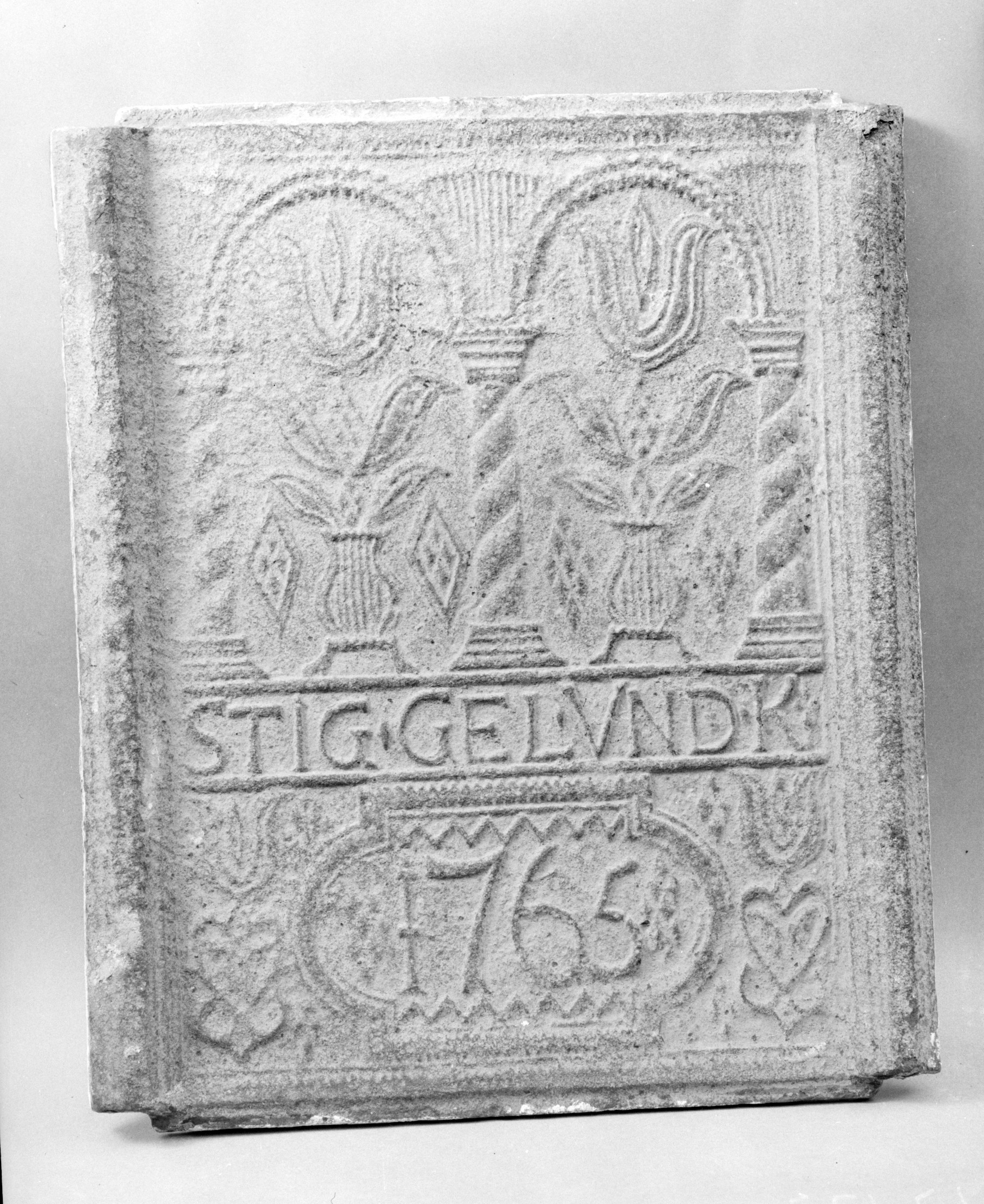
Jamb stoves were an old technology, already being replaced, even in some German homes, by a new design -- the closed, six-plate stove (see below) -- well before the Revolution.  So it is understandable that few of them survive intact.  By the time that Henry Mercer and other late 19th century antiquarians began to collect them and celebrate them as a distinctive kind of folk art, most of what they found were single plates that had been discarded decades earlier and, mostly by chance, not sold as scrap to be remelted.  One of the best collection of these plates is at the Bucks County Historical Society's Mercer Museum in Doylestown, PA, built on Mercer's enthusiasm -- see his pioneering The Decorated Stove Plates of the Pennsylvania Germans (Doylestown: McGinty's Job Press, 1899), to accompany an early exhibition, and his magnum opus The Bible in Iron; or, the Pictured Stoves and Stove Stove Plates of the Pennsylvania Germans (Doylestown: Bucks County Historical Society, 1914). But the catalogue only seems to include images for half-a-dozen of them. Fortunately a nearby museum's online collection is much better. The Winterthur has almost a dozen C18th plates, mostly from S.E. Pennsylvania furnaces -- search "stove" and "stove plate." Many of the plates in both collections are from early six-plate rather than jamb stoves, but until the advent of new rococo designs in the 1760s and 1770s to suit the taste of furnaces' "English" owners and their new "English" or increasingly Anglicized German customers, they did not differ much.

http://images.metmuseum.org/CRDImages/ad/original/139868.jpg


Henry William Stiegel (Charming Forge, PA), Jamb Stove Plate (1765)22 1/2 x 19 in. (57.2 x 48.3 cm), Accession Number 47.137.10.


There are other good online images of Pennsylvania German and early "British" Pennsylvanian stove plate, e.g. http://www.cowanauctions.com/auctions/item.aspx?ItemId=28892 for a 1762 plate from York County with the same sort of vernacular decoration, sold in 2005 for $3,335.


[Update, 16 Jan. 2014: There is also an excellent collection -- eighteen stove plates, c. 1720s-1760s, at Yale Art Gallery.]

But the fate of most old stoves is not to end up in public or private collections, so one cannot tell for sure whether or how well the few surviving stoves and plates are representative of the lost multitudes.


Scrap Pile, Hopewell Furnace N.H.S., April 2009


AMERICAN STOVES, c. 1760-1850: 6-, 9-, AND 10-PLATES


Neither the Met nor, strangely, the Philadelphia Art Museum seems to have a good version of the most common stove types in America from the 1760s until, probably, at least the 1830s, i.e. 6-plate "box stoves" and the 9- or 10-plate versions which were adapted for cooking with the addition of a small oven and, by the early C19th, one or more "boiling holes" in the top surface.  (See the stoves illustrated in most of the pictures in my post "The Ubiquitous Stove: Stoves in Public Places," as well as the first illustration in this blog.)  For these, one needs to turn to the collections of other museums, notably the Winterthur, which has good examples of all three, and, for some of the earliest surviving models, to other regional collections.


1772 Mark Bird 6-Plate Stove, Hopewell Furnace, PA; 35" L x 41" H x 18" W; Birdsboro Community Memorial Center, Birdsboro, PA; on loan to, and on display at, Hopewell Furnace N.H.S. (Heckscher & Bowman, American Rococo, p. 224).

This fine stove is the only early 6-plate for which I can find a good-quality image online.  It was of a type probably introduced into the Colonies three or four decades earlier, and is derived from a northern European design, the "Holland," "Dutch," "draft," or "wind stove," sometimes even called an "English stove" because the Dutch originals were imported to the seaboard colonies via Britain.  Local manufacture began in the 1740s-1750s.  

As we can see, it differed from the jamb stove in several respects, notably that (i) it contained its own fire of long pieces of wood rather than live coals shoveled in from the kitchen fireplace, and had its own flue at the rear of the top plate, (ii) it was therefore free-standing and portable (though very heavy!), and could be installed wherever its owner wanted it rather than requiring a Pennsylvania German central chimney, and (iii) by the 1760s-1770s its decorative scheme had become rococo rather than Pennsylvania German vernacular.  In the beginning, though, techniques of manufacture were much the same as for jamb stoves, in the same rural furnaces, and styles of decoration were probably still German too.  


The change in pattern-making style and technique in the 1760s was because furnace owners (generally British American) began to commission them from Philadelphia carpenters, and also because the market for 6- and 10-plates was broader than that for jamb stoves and included British American consumers as well as wealthier and more assimilated German Americans who were embracing their neighbors' modern taste.  Rococo decorative details were often simply pinned and/or glued to the boards of the wood pattern plate rather than being carved into them, whereas jamb stove plates had been all carved.  Even after this change, the plates were still generally cast in "open sand" on the furnace floor, and were thick and flat, heavy and quite rough.  In 1771 the Elizabeth Furnace in Bucks County made 6-plates in three sizes, varying in weight from 250 to 450 pounds. 


The 6-plate became an even more useful appliance in the 1760s when it was adapted to include a small oven.  This was done by cutting a rectangle out of each of the side plates, fitting four more plates stretching from side to side of the stove (top, bottom, front, back), hence the name, 10-plate, and closing each side of the resulting small oven with a wrought-iron door. The Thomas Maybury stove in the Ford Museum, Dearborn, MI, so called after the ironmaster whose furnace made it and whose name it bears, dates from 1767, and is the oldest surviving 10-plate -- Hereford Furnace in Bucks Co., PA, where it was cast, is said to have been the first to make them. There is a good image of this survivor in Peirce, Fire on the Hearth, p. 94, with dimensions, and better ones at the Ford Museum itself.  


Ford Museum Object No. 28.402.1, Dimensions 33" high x 28" wide x 37.5" long, http://collections.thehenryford.org/Collection.aspx?objectKey=10104


The Maybury stove has an interesting history -- it was brought forward in 1892 by a member of the public in response to the offer of a $100 reward for the oldest cooking stove, in the best condition (in proportion to average wages, that would have been a $21,000 tempter in 2012) by the Michigan Stove Co. of Detroit, then one of America's largest, which wanted an exhibit for its stand at the Chicago World's Columbian Exposition. The firm's superintendent and chief designer, William J. Keep, an enthusiastic stove historian, subjected it to close analysis, so we know more about it than almost any other.


1769 Henry W. Stiegel 10-Plate Stove, Elizabeth Furnace, PA; 63.25" L x 44.25" H x 15" W; Hershey Museum, Hershey, PA. (Morrison Heckscher and Leslie G. Bowman's classic American Rococo, 1750-1775: Elegance in Ornament (New York: Metropolitan Museum of Art, 1992), p. 226).

The Stiegel stove illustrated above is also one of the earliest, as well as (in the opinion of Morrison Heckscher) one of the finest, rococo 10-plate stoves in existence.  Even without looking inside it, one can work out its internal arrangement -- particularly with the assistance of Keep's careful study of the Maybury stove.  The oven extended all the way to the front of the stove, i.e. it was larger than the door opening.  This meant that smoke and flames travelled in a recumbent U-shaped path, round the back of the oven, then along the underside of the top plate to a smoke-pipe collar at the front.  The small hatch at the top of the front plate was to give the user access for cleaning out the soot that accumulated on the oven's inaccessible top with a long-handled scraper.

In due course (i.e. it is not clear when) makers made a small but significant modification to the ten-plate, rendering it somewhat easier and cheaper to make.  They dispensed with the front plate of the oven box, whose only purpose was to keep the upper and lower plates in place, and cast locating grooves onto the insides of the main stove plates (front, sides) instead. This enabled them to make the oven a bit bigger and more usable too.


There is no contemporary drawing of a 9-plate (that I know of) to make its internal arrangements clear, apart from one good near substitute: Philadelphia stove dealer Nichodemus Lloyd's patent 1676X (1812), which aimed to increase the amount of oven space over that in a standard 9-plate stove by having two smaller ovens, one above the other, with the smoke and flame taking an S-shaped path behind the back of the lower oven, along its top to the front, and then up the front of the upper oven, then back to a smoke pipe located more conveniently at the rear of the stove.  As the drawing makes clear, Lloyd fitted soot-scrapers in both of his horizontal flues. 


The following three illustrations demonstrate how easy it was to make a 9- or 10-plate and a 6-plate using the same patterns for the external plates, especially the front, back, and sides, which were commonly decorated.  There wasn't even any need for separate side-plate patterns (the largest and most costly) -- as the Batsto pattern (a rare survivor, possibly because it was made of mahogany rather than the cheaper and more common white pine) makes clear, the pattern simply had a removable hatch in the middle, held in place by cleats on the back.  Take the hatch out, and you make a 9- or 10-plate casting, with a rather plain wrought-iron oven door to cover the hole; leave it in and you get a 6-plate, for heating only, but with a more attractive appearance to compensate.


http://images.metmuseum.org/CRDImages/ad/original/DP145749.jpg

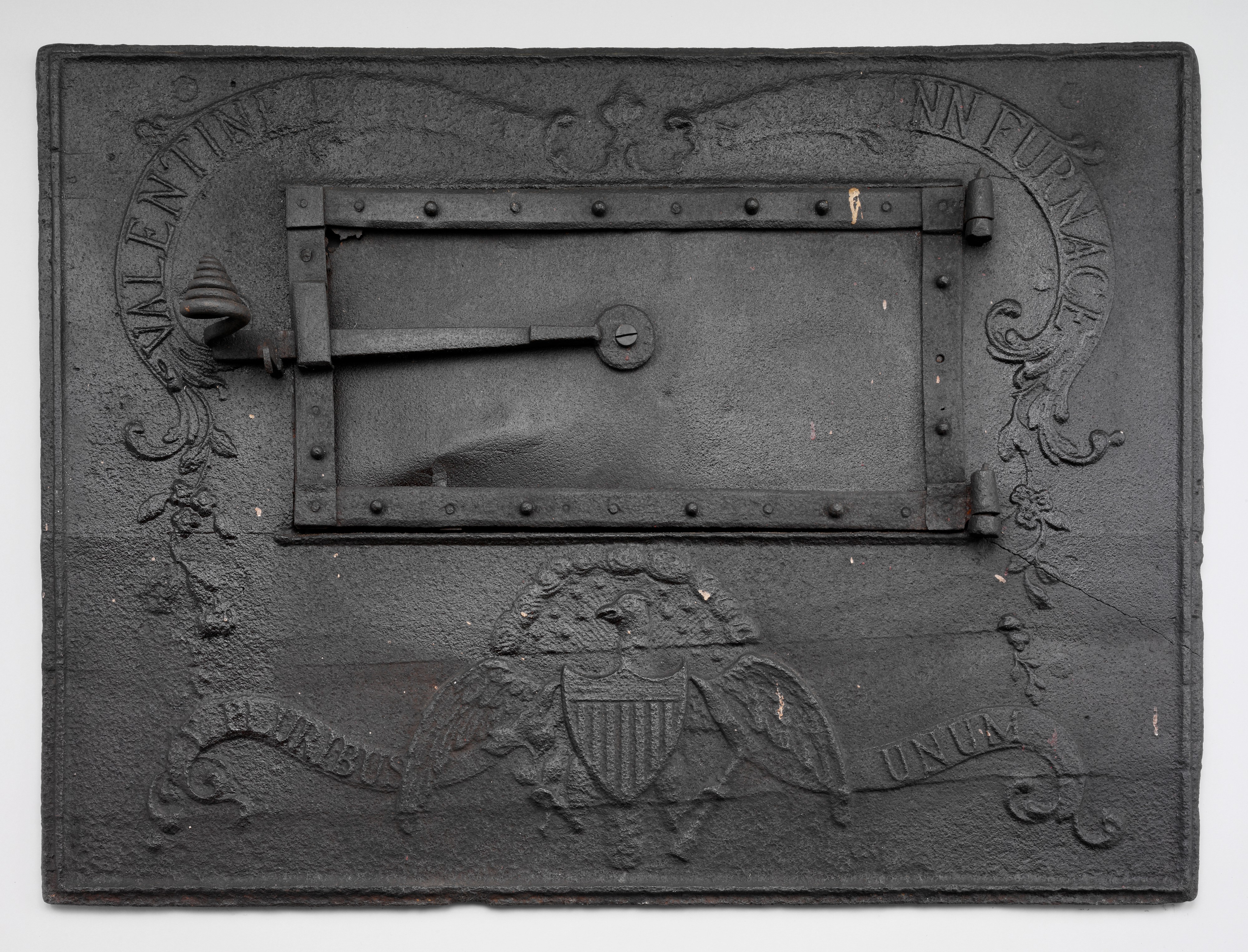
Valentine Eckert (Sally Ann Furnace, PA), Side of Ten-Plate Stove (ca. 1791-1803)26 x 35 in. (66 x 88.9 cm), Accession Number 2006.549.

This should be compared with a wonderful picture in Heckscher and Bowman's classic American Rococo, p. 228of the fine mahogany pattern for a very similar rococo stove from Batsto Furnace, NJ, and the Historic American Buildings Survey's image of a rather decrepit surviving example of the stove itself, in its 6-plate version:


http://www.loc.gov/pictures/collection/hh/item/nj0300.photos.111029p/
 (http://www.loc.gov/pictures/collection/hh/item/nj0300.photos.111030p/

for another picture of the pattern)


c. 1787-1810, John Brien, Catoctin Furnace, MD, described as a 9-Plate; 38.5" (H) , 15.551" (W) , 49.752" (D) [97.79 (H) , 39.5 (W) , 126.37 (D)]; Winterthur Museum Obj. No. 1960.0771.  Though the stove looks stylistically C18th, so a date towards the beginning of the suggested range seems defensible, there is a problem: John Brien did not buy the furnace until 1820.  It thus seems more probable that the furnace, somewhat removed from the main stove-manufacturing district in the Philadelphia hinterland (160 miles away across the mountains, whereas Hopewell, for example, was just 50 miles up the Schuylkill valley), was a bit backward, and perhaps its market's tastes too.

The Winterthur's rather crude, slabby, and barely decorated Brien stove -- with just a few patriotic details, an eagle and Washington's head, pinned to an otherwise flat pattern -- is described as a 9-plate, and has the same features as the much earlier Maybury and Stiegel (i.e. soot-scraping hatch and location of smoke-pipe collar).  It also seems, more clearly than  the Stiegel, to bear a couple of other signs of technical progress in the arts of stove design and manufacture.  The flat plates -- sides, front, back, and oven (the three internal plates) were probably still cast flat, but the base plate, with its raised rim, and the top, with its stove-pipe collar cast as an integral part of the plate rather than, as in the case of the 1772 Hopewell stove, probably just cemented on, are most likely to have been cast by a new method -- in two-part frames ("flasks") of sand, with a double-sided pattern between the flasks to make both the upper and lower surfaces (with open sand casting, patterns were single-sided, as the top of the casting was open to the air; gravity simply ensured that the puddle of molten iron poured into the open mold ended up reasonably flat).  

Flask casting, though more difficult and costly than the old open-sand method, had many advantages: castings were flatter, smoother (on both sides), thinner, and could be more complicated (the stove-pipe collar, the rim on the base plate, retaining grooves for the oven plates).  A saving on raw material could make up for some of the increased labor cost, and the joint between base, top, and side plates could be made tighter, reducing problems of smoke and ash leakage into the room, and making the fire more controllable.


c. 1815-1825 Henry Schreiner, Philadelphia, PA, "New Orleans Victory" 9-Plate Stove; L 30" including hearth (76.3 cm) W. 13 3/8" (33.9 cm) H. 31 1/2" (80 cm) including base; Old Sturbridge Village Collection No. 2.77.90.

By the time the John Brien stove was being made at the Catoctin Furnace in the 1820s, technical and design progress in the Philadelphia hinterland had made it look very old-fashioned.  The Schreiner, Richards, and Slaymaker stoves (below) were the mature form of the 9- or 10-plate that turned these stoves into mass-market products reaching new consumers up and down the Eastern Seaboard and deep into the interior, wherever water transport permitted.  All of these stoves' plates were now flask-molded, so that they were thinner, lighter, cheaper, more crack-resistant, and easy both to decorate (in both of the first two cases, with patriotic and Federal-style images; the Slaymaker, a little later, is more elaborateand to curve.  The classic cooking stove became much more attractive to look at as it assumed its characteristic ovoid shape (see the 1812 Lloyd patent drawing, above), with only two external plates still needing to be flat: the top and the base.  This product remained on the market until the end of the century as a cheap staple, known by then as simply an "old Philadelphia"-style stove.


1827 9-Plate Stove (incorrectly described in catalogue as a 6-plate; note oven, stove-pipe position, and soot-scraper door), John Richards & Co., Union Furnace, Berks Co., PA.; 38.5" (H) , 29.724" (L) , 16.374" (W) [97.79 cm (H) , 75.5 (L) , 41.59 (W)]; Winterthur Museum Obj. No. 1998.0021.002.  


The best way of understanding the construction of an "Old Philadelphia" stove is by examining pictures of the several plates of an incomplete, disassembled, late 1820s-1830s stove in the Winterthur Collection: a Henry Slaymaker & Co. 10- (or 9-?) Plate from his Margaretta Furnace, opened in 1826, most conveniently viewed online.  

Slaymaker's was an exceptional furnace, both in terms of its metal quality and its craftsmanship: as we can see, even the firebox and oven doors were now cast, curved, and attractively decorated.  Slaymaker was one of the principal suppliers (after Clement Brooke's Hopewell Furnace) to Powell Stackhouse, Jr., probably the largest stove dealer in Philadelphia (and a fine inventor and pattern maker himself, hence, probably, the design quality of the stoves that he had made for him), so it is particularly fortunate that one of his products from the last decade of the stove furnace region's prosperity and importance, and at the peak of its technical and artistic development, should survive.  (See the map of Powell Stackhouse's suppliers, 1831-1841, which shows the region at its fullest extent, and also how remote John Brien's Catoctin Furnace, near Thurmont, MD, was from it.) 


Base of Slaymaker Stove, drilled for the long internal bolts holding these stoves together (in the other models shown, they are still external and visible, whereas with the Slaymaker only the nuts would show, on the top plate, and as the Schreiner and Richards stoves show, these could be made into decorative features).  


[Slaymaker references:
  • "Mr. Slaymaker's Furnace Produces Excellent Stoves," Republican Compiler [Gettysburg, PA], 8 Nov. 1826, http://genealogytrails.com/penn/york/newspaper.html, from "Miscellaneous Newspaper Articles From the Past: York County Pennsylvania." -- "The stoves cast at Margaretta (Mr. Slaymaker's) Furnace in this county, deserve honorable mention. The patterns are neat and handsome and in smoothness the castings are not excelled, if equaled, by any that have come under our notice. The pigs produced at this furnace are said to be of superior quality." 
  • Persifor Frazer, Jr., Second Geological Survey of Pennsylvania 1874: Report of Progress in the
    District of York and Adams Counties ... (Harrisburg: Board of Commissioners
    for the Second Geological Survey, 1876), pp. 20, 22, 
    http://www.archive.org/stream/reportprogress40penngoog#page/n34/mode/1up.]


Another, though less good, way is by looking at the following photo of a Hopewell Furnace exhibit, an "Old Philadelphia"-style stove with one side removed:


It's not just my reflection in the glass of the museum cabinet that makes this model a bit difficult to read, but also that one cannot quite work out where the smoke passages are -- probably between the rear of the rectangular oven, which now took up a much larger amount of the internal space than in the first 10-plates fifty years earlier, and the rounded rear plate (the rounding therefore might have had a functional purpose as well as being intended to make the stove more pleasing to look at).  The soot-scraper had been moved to the back of the stove -- that's the purpose of the little projection at the top right, a finger-loop at the end of a long rod with the scraper at the end of it, as in Lloyd's patent drawing; the rear plate of the Slaymaker shows the same tell-tale feature, though the rod is missing.


* * *

This posting became too long, so I decided to split it.  Part II is about Franklin stoves, Part III, about columnar and parlor heating stoves from the 1830s-1850s, and Part IV is about "Shaker" stoves -- the three other main stove types that seem to populate museum collections.